Background
Kecskemét’s first Cycling Network Plan was completed in 2014. Since then, the city’s cycling infrastructure has developed significantly: new network elements have been built, some existing facilities have been renovated, and the bicycle network has expanded in the northern and southern parts of the city, as well as in the Southern Economic Zone. At the same time, numerous problems already identified in the previous plan persist, particularly regarding the continuity of the network, key junction crossings, and the quality of certain infrastructure elements.
In addition to changes in cycling conditions, the need for this review was driven by the preparation of the Kecskemét Transportation Concept 2025, which was also developed by Mobilissimus. The revision of the network plan was conducted in parallel, as part of the same planning process, and in close connection with the revision of Kecskemét’s Sustainable Urban Mobility Plan (SUMP). Therefore, during the planning process, we took into account not only the experiences from the previous Cycling Network Plan but also the latest transportation studies and the city’s current development directions.
Bicycle rack
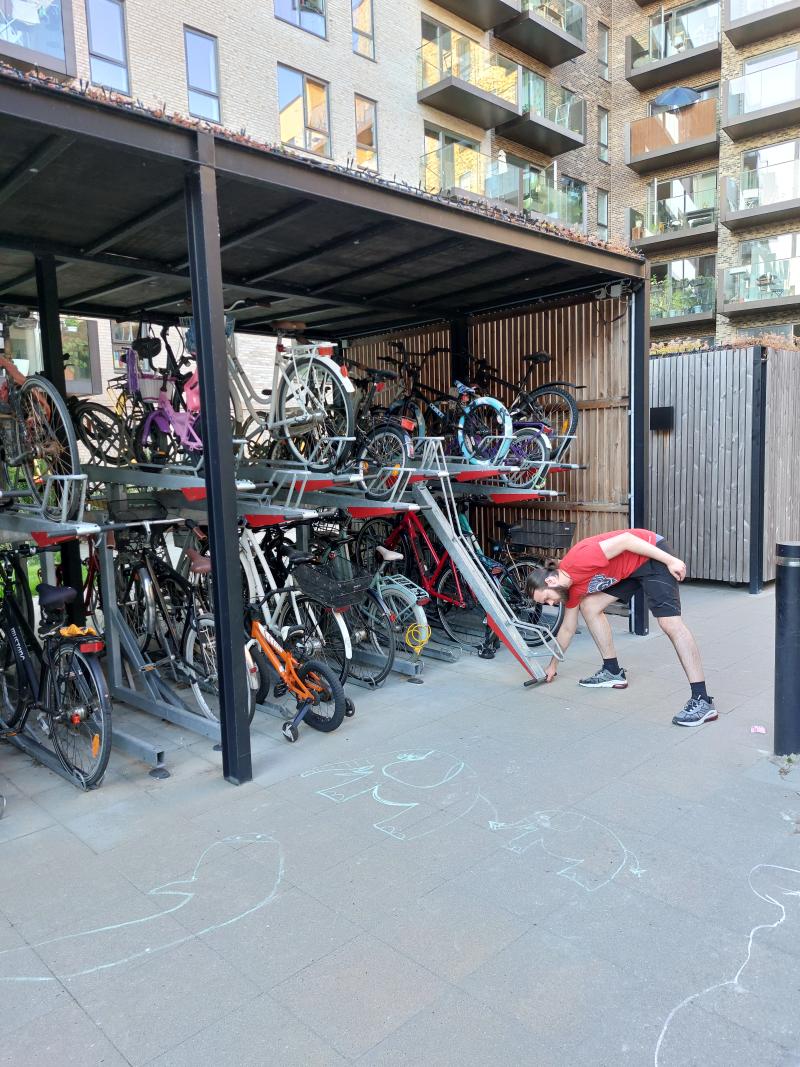
Photo: Imre Kanalas
Revision of the Cycling Network Plan
The goal of this project was to conduct a comprehensive assessment of the cycling situation in the city and its surrounding areas, identify factors hindering cycling, and develop a framework that would help make it a viable alternative for even more people in their daily urban commutes.
Kecskemét has favourable conditions for cycling: it is flat, cycling has traditionally played a significant role, and there are well-functioning cycling facilities at several locations throughout the city. According to the 2022 census, the share of cycling for commuting to work and school was 10.6%. However, this figure was still 15% in 2011, while motorization in the city has increased significantly since.
One of the most important findings of the studies is that Kecskemét does not primarily need a multitude of segregated bike paths, but rather the development of a coherent, uniform-quality, and safe urban backbone network. Key problems include intersections that disrupt the network’s continuity, the lack of crossings over the railway tracks and the M5 motorway, and certain sections of low technical quality. Improving connections between the southern parts of the city and the downtown area is also an important task.
Accordingly, the revised plan outlines several interrelated development priorities. First, it aims to fill in the missing key elements of the existing network and establish important connecting routes at key junctions, as well as to improve the quality of the busiest existing sections. In addition, key objectives include making the downtown area bicycle-friendly, creating high-quality main corridors connecting the city’s neighbourhoods to downtown, and ensuring adequate connectivity for the southern neighbourhoods.
In addition to developing the urban network, the plan also addresses the creation of recreational and tourist cycling routes, as well as the strengthening of cycling connections to neighbouring municipalities —Ballószög and Helvécia—in line with the Bács-Kiskun County Cycling Network Plan. In addition, special attention is given to developing bicycle parking facilities and strengthening the connection between bicycle transportation and public transit. As part of this, Bike&Ride facilities, the expansion of bicycle transport options, and the development of data collection and data-driven planning related to bicycle transportation play an important role.
Carfree day
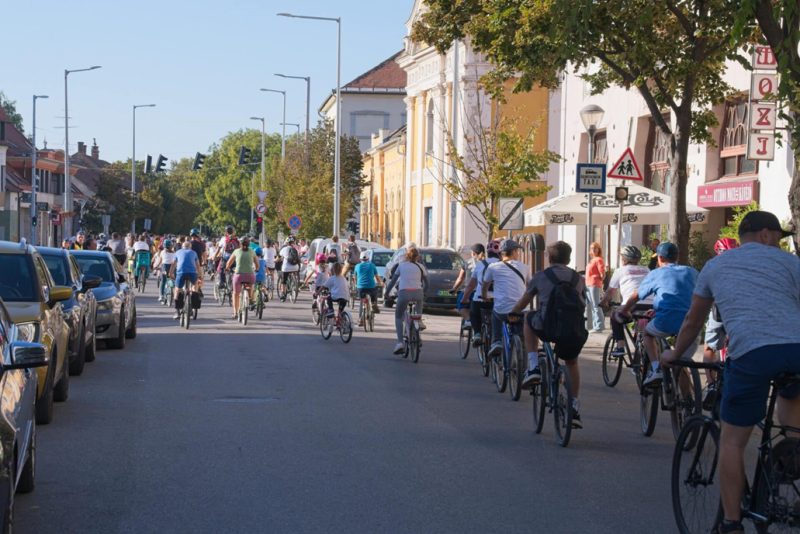
Photo: Imre Kanalas
The improvements do not consist solely of infrastructure projects. The plan also proposes organizational and operational tasks, regular bicycle traffic counts, awareness-raising and educational measures, as well as cycling events. Implementation has been outlined in short-, medium-, and long-term phases, allowing the development plans to be carried out gradually and in a coordinated manner.
As a result of the revision, Kecskemét now has an updated cycling network plan that, building on the strengths of the existing infrastructure, identifies the missing elements of the network, the most important areas for intervention, and long-term development directions. The goal is to create a cohesive, safe, and high-quality cycling system that supports daily commuting, recreational cycling, and regional connections alike.
Client: AIPA Ltd.
Year of fulfilment: 2025–2026
Cover photo: Imre Kanalas